
The FRP Advantage: Outlasting Metal
Facility managers and engineers across laboratories, higher education institutions, and wastewater treatment plants face a persistent challenge: managing ventilation systems in chemically aggressive environments. Traditional steel-based fans and exhaust systems, even when coated, deteriorate rapidly when exposed to corrosive airstreams containing acids, bases, salts, and biological byproducts.
The consequences are costly and cascading. A corroded steel impeller doesn't just underperform - it fails. When systems fail, operations halt. Laboratories lose research time. Wastewater treatment facilities experience operational disruptions. Higher education institutions face expensive emergency repairs during critical periods. The indirect costs: unplanned downtime, emergency maintenance calls, and accelerated replacement cycles often exceed the cost of the equipment itself.
Traditional mitigation approaches fall short. Coated steel systems—whether epoxy, polyester, or other protective finishes—provide temporary relief. But coatings degrade. Once breached, corrosion accelerates beneath the surface, hidden and insidious. This means repeated recoating cycles, extended maintenance windows, and the persistent risk of catastrophic failure.
The weight of traditional systems compounds the problem. Steel fans and ductwork are heavy, requiring robust structural support, specialized installation labor, and reinforced HVAC infrastructure. In retrofit situations, common in aging laboratories and higher education facilities, this weight becomes prohibitive, requiring facility upgrades that add months and substantial cost to projects.
For facilities managing corrosive environments, traditional steel systems represent a cycle of diminishing returns: initial capital investment followed by escalating maintenance costs, recurring downtime, and premature replacement.
The Solution: FRP Technology from MK Plastics
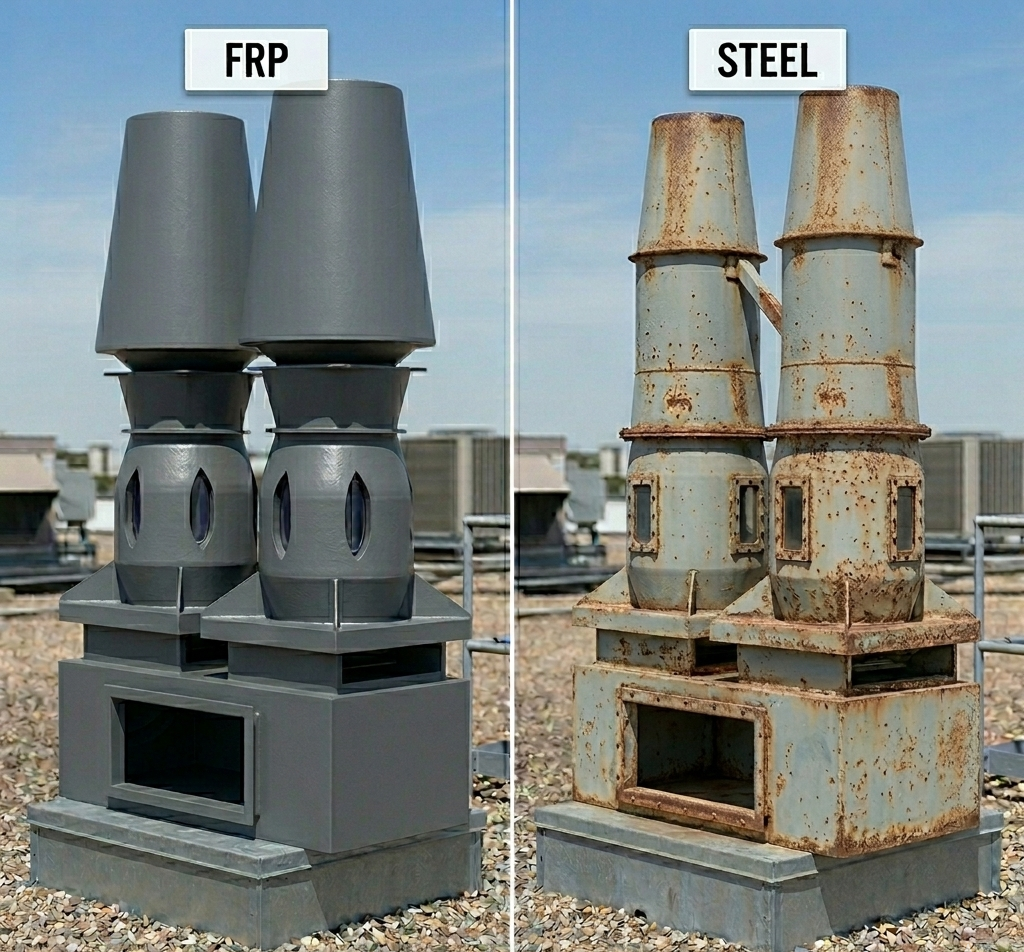
Fiber-Reinforced Polymer (FRP) represents a fundamentally different approach - one engineered specifically for chemically aggressive environments. Unlike steel, FRP is inherently corrosion-resistant. It doesn't rust. It doesn't corrode. It doesn't require protective coatings that degrade over time.
MK Plastics FRP fan and exhaust systems are manufactured with resin systems specifically formulated for exposure to laboratory chemicals, wastewater treatment gases, and other corrosive airstreams. This isn't a coating; it's the material itself. Every surface - including impellers, housings, and plenums - provides the same level of chemical resistance.
Direct Competitive Advantages:
Inherent Corrosion Resistance: Traditional coated steel systems rely on coatings as their line of defense. Once compromised, corrosion begins beneath the surface. FRP systems have no coating to fail. The material resists the same chemical attack that destroys steel - whether sulfuric acid mist in laboratories, hydrogen sulfide in wastewater treatment, or salt-laden air in other industrial applications. This isn't a temporary fix; it's permanent material resistance.
Superior Lifespan and ROI: MK Plastics FRP systems deliver predictable, extended operating life, often 25+ years with minimal maintenance. Steel systems (coated or stainless) typically require replacement within 10-15 years in corrosive environments. When you calculate total cost of ownership (initial purchase, installation labor, maintenance cycles, downtime costs, and replacement), FRP systems often deliver 40-60% lower costs over a 25-year horizon, despite potentially higher initial capital expenditure.
Lightweight and Installation Flexibility: FRP weighs approximately 40% less than equivalent steel systems. This advantage is transformative in retrofit applications. Lightweight FRP systems can often be installed in existing ductwork, on existing structural support, and with minimal facility modifications. Heavy steel replacements, by contrast, frequently require facility upgrades: new supports, reinforced penetrations, extended installation windows. For higher education and laboratory environments where operational continuity is critical, the lightweight advantage enables faster installation with less disruption.
Zero Maintenance Coatings: Steel systems require ongoing inspection and recoating - typically every 5-10 years depending on chemical exposure. FRP systems eliminate this recurring cost and operational burden. No recoating. No coating inspections. The material resists its environment indefinitely.
Proven Performance: MK Plastics brings decades of experience engineering FRP solutions for demanding chemical environments. Their systems are deployed across the industries most hostile to steel - laboratories, wastewater treatment facilities, and higher education institutions - with documented performance records and verified longevity.
Making the Decision
For facilities managing corrosive environments, the choice between traditional steel and FRP systems ultimately reduces to a single question: What is the true cost of equipment that corrodes, requires ongoing maintenance, and fails prematurely?
MK Plastics FRP solutions eliminate corrosion as a threat. They reduce maintenance burden. They deliver genuine extended lifespan. They enable faster, less disruptive installations. For laboratories, wastewater treatment plants, and higher education facilities managing chemically aggressive airstreams, FRP isn't simply better than steel, it's the engineered solution to a problem steel cannot reliably solve.
Ready to explore how FRP can solve your facility's ventilation challenges? Contact us to discuss your specific environment, evaluate system requirements, and understand the complete cost picture - not just initial capital, but the full 25-year cost of ownership.
